What is a camera module and how does it work?
In today's digital age, the camera module has become an essential component in various devices. Dr. Emily Tran, a leading expert in imaging technology, once stated, "The camera module is the eye of our devices, bringing the world to life." This statement captures the significance of camera modules in smartphones, drones, and security systems.
A camera module typically consists of a lens, image sensor, and supporting electronics. These parts work in harmony to capture images and video, helping users document moments. The advancements in camera module technology have led to improved image quality and performance. Yet, challenges remain in achieving perfect functionality under all conditions.
Despite their capabilities, camera modules can struggle in low-light environments or fast-moving scenarios. Users often seek clearer images in challenging situations. This highlights a need for continuous innovation in the industry. As the market grows, the focus on enhancing camera modules remains crucial for creating better user experiences and meeting evolving demands.
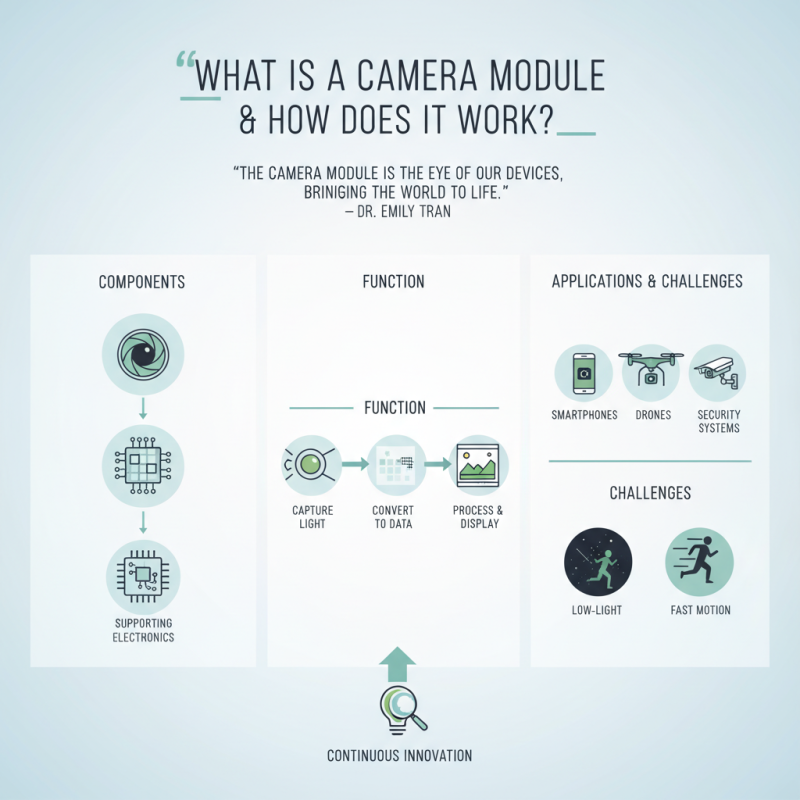
What is a Camera Module?
A camera module is a compact device that combines a camera sensor, lens, and circuitry. It's an essential component in smartphones, drones, and security systems. According to a recent report by MarketsandMarkets, the global camera module market is projected to reach $50 billion by 2025, driven by rising demand for high-quality imaging in consumer electronics.
Understanding how a camera module works involves knowing its basic parts. The image sensor captures light and converts it into electronic signals. These signals are then processed to create digital images. Camera modules use different types of sensors, such as CCD or CMOS, each with unique characteristics. CMOS sensors dominate the market due to their lower power consumption and faster processing speeds.
Tips: When choosing a camera module for your project, consider the resolution and low-light performance. Higher resolutions yield better image quality but can consume more power. Test various modules to find the right balance for your needs. Users should also be aware of potential complications like lens distortion in wide-angle modules. Understand that not every module will meet all requirements perfectly, prompting a need for compromises in design. Be prepared to adjust based on actual performance during real-world usage.
Components of a Camera Module
A camera module consists of several key components. Each part plays a role in capturing and processing images. The lens is the first element. It focuses light onto the sensor. The sensor converts light into electrical signals. Different types of sensors exist, including CCD and CMOS. They vary in performance and image quality.
The housing of the module protects the components inside. It also helps in managing heat. Sometimes, additional features like image stabilization are included. This can drastically improve photo quality.
**Tip**: When choosing a camera module, consider its sensor type. A high-resolution sensor can enhance the clarity of images.
Another crucial component is the image processor. It controls how the images are processed and stored. This influences the final output quality. Poor image processing might lead to blurry or distorted images.
**Tip**: For better results, learn about different image processing technologies. Understanding this can help you make informed choices. A well-rounded approach can yield better performance from a camera module.
What is a camera module and how does it work? - Components of a Camera Module
| Component | Function | Description |
| Lens | Focus light | Glass or plastic that focuses light onto the sensor. |
| Image Sensor | Capture image | Converts light into electronic signals for image processing. |
| Aperture | Control light exposure | Controls the amount of light reaching the sensor. |
| Shutter | Control exposure time | Opens and closes to expose the sensor to light for a specified duration. |
| Processor | Process image data | Processes the signals from the sensor to create an image. |
| Interface | Connect to devices | Allows communication between the camera module and other devices (e.g., USB, Wi-Fi). |
How Camera Modules Capture Images
Camera modules are essential components in many devices, including smartphones and drones. They capture images through a precise interplay of optics and sensors. The core function of a camera module revolves around converting light into electrical signals, a process that transforms visual information into digital formats.
The image capture begins with light entering the lens. The lens focuses this light onto the image sensor. This sensor, often made of silicon, is where the magic happens. It contains millions of tiny photodiodes that convert light into voltage. Each photodiode corresponds to a pixel in the final image. The more photodiodes there are, the higher the resolution.
Tips: When choosing a camera module, consider the resolution and sensor size. Higher resolution leads to clearer images. Don't ignore the importance of lighting conditions. Poor lighting can degrade image quality, regardless of sensor specs. It's wise to test different modules in varied settings to understand their performance.
In addition, some camera modules incorporate advanced features like autofocus and image stabilization. However, these can introduce complexity. Not every device requires high-end features. Assess your needs carefully. A simple module might be more effective for your specific application. Sometimes, less is more in technology. Embrace this simplicity for practical use.
The Working Mechanism of Camera Modules
Camera modules are essential components in modern photography and videography. They comprise various parts that work together seamlessly. Understanding their working mechanism reveals how they capture images. Each camera module includes a lens, image sensor, and circuitry.
Light enters through the lens and hits the image sensor. The sensor converts light into electrical signals. This process happens rapidly. The quality of the image depends on several factors, including the sensor's size and resolution. Cameras with larger sensors typically capture more detail. However, this also can make them bulkier and less portable.
The circuitry processes the signals into viewable images. In this stage, there can be imperfections, such as noise or distortion. Engineers must continually refine algorithms to improve image quality. Dark areas may appear grainy. Bright highlights can lose detail. These challenges prompt ongoing enhancements in camera technology. Each advancement offers better images but may not resolve all issues, reminding us of the balance between innovation and practical limitations.
Camera Module Performance Comparison
Applications of Camera Modules in Modern Technology
Camera modules play a pivotal role in various aspects of modern technology. They are widely used in smartphones, drones, security systems, and even medical devices. Each application leverages the module's ability to capture images and video effectively. In smartphones, camera modules have become essential for communication and social media sharing. People expect high-resolution images, pushing technology to evolve rapidly.
In drone technology, camera modules help in navigation and aerial photography. They provide real-time footage for surveillance and mapping, which can be vital for various sectors, including agriculture and mining. The infrared capabilities in some camera modules enable night vision, further broadening their use in security applications.
*Tip: Consider the environment where the camera module will be used. Extreme weather can affect performance. Choose modules designed for specific conditions to ensure reliability.*
Another important application is in medical imaging. Camera modules are integrated into endoscopes and imaging devices. They assist in minimally invasive surgeries and diagnostic procedures, improving patient outcomes. However, issues like image latency can occur. Understanding these limitations is vital for healthcare professionals.
*Tip: Always test the camera module in a controlled setting before use in critical applications. This helps identify potential flaws that could affect results.*