
How to Choose the Best ESD Safe Flooring in China?
Choosing the Best Esd Safe Flooring in China requires more than comparing product prices. A reliable floor must control static electricity, support daily production, and remain stable under local conditions. Southern factories may face high humidity, while northern facilities often experience dry winter air. These differences can change performance.
Dr. Steven L. Halperin, a respected ESD consultant, offers a practical warning: “ESD control is a system, not a single product.” His point matters when evaluating vinyl, epoxy, rubber, or raised-access flooring. The floor works with conductive footwear, grounding devices, maintenance routines, and verified installation. One isolated test result cannot prove complete protection.
Look closely at the production area. A smooth light-gray surface may suit electronics assembly, but forklifts can expose weak joints and worn coatings. Ask for resistance test data, grounding details, chemical compatibility, fire-performance information, and installation references in China. Check whether the supplier understands IEC 61340-5-1 and relevant local requirements. Testing should happen before handover and during operation.
A low resistance number alone can mislead. It may hide poor grounding or careless cleaning. This is where many purchasing decisions become too simple. The best Esd Safe Flooring is not always the cheapest or the most technically impressive option. It should match personnel movement, equipment weight, climate, maintenance capacity, and the risks of the room. Some recommendations may need revision after a site survey. That is not a weakness. It is responsible engineering.
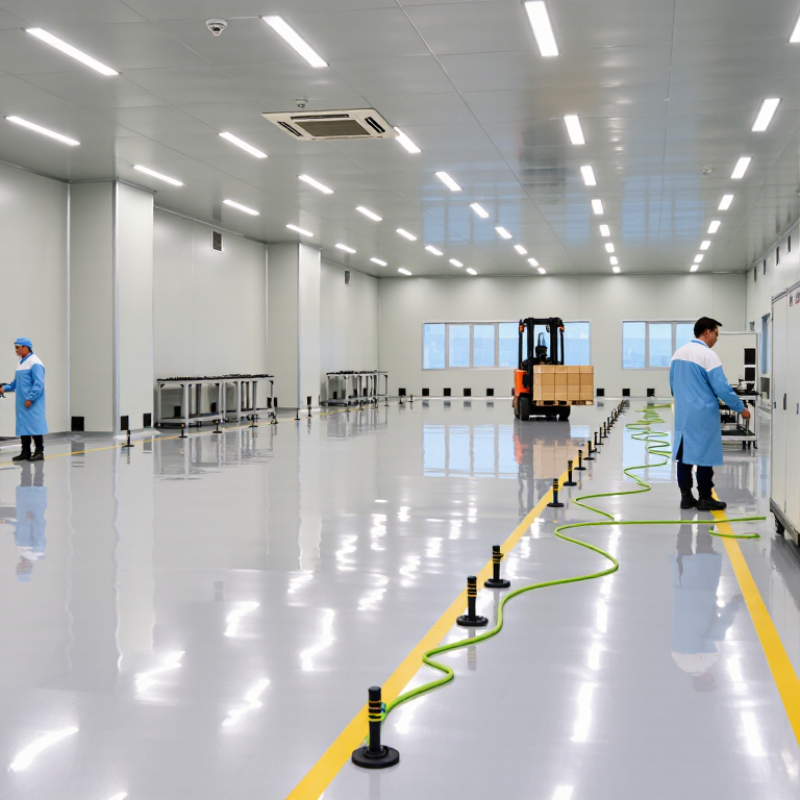
Define ESD Risk and Set a Resistance Target of 10⁶–10⁹ Ω
Choosing ESD-safe flooring in China starts with defining the actual ESD risk. Electronics assembly, cleanrooms, warehouses, and repair areas do not share the same exposure. Sensitive devices may face damage from people, carts, tools, or packaging. IEC 61340-5-1 and ANSI/ESD S20.20 commonly control the resistance path to ground below 1.0 × 10⁹ Ω. In practice, many facilities set a flooring target between 10⁶ and 10⁹ Ω. This range supports controlled charge dissipation without creating an unnecessarily conductive surface.
Resistance is not a single laboratory number. ANSI/ESD STM7.1 evaluates floor materials, while ANSI/ESD STM97.1 and STM97.2 assess the footwear-flooring system. Test dry and humid conditions. Test clean and contaminated areas. A floor can measure 10⁷ Ω when new, then exceed 10⁹ Ω after wax, dust, or poor grounding appears. That detail is easy to miss. A target without a test plan is only decoration. Site experience also shows that humidity changes performance, especially during northern China’s dry winter months. The specification should include resistance tolerance, grounding points, cleaning chemicals, traffic load, and retesting frequency.
Tips: Request factory test data using recognized ESD methods. Confirm resistance at seams, ramps, and doorway transitions. Check the complete footwear-flooring path, not the tile alone. Record temperature and humidity during acceptance testing. If readings fluctuate widely, stop and investigate; the floor may not be the only problem.
How to Choose the Best ESD Safe Flooring in China? - Define ESD Risk and Set a Resistance Target of 10⁶–10⁹ Ω
| Decision Dimension | Practical Requirement | Recommended Target or Range | Verification Method | Selection Notes |
|---|---|---|---|---|
| ESD risk level | Identify whether the area handles electrostatic-sensitive devices, flammable materials, explosive atmospheres, or only general electronic assemblies. | Use a controlled ESD floor system for areas where electrostatic discharge can damage products or create a safety hazard. | Review process risk, device sensitivity, personnel movement, footwear, humidity, and grounding design. | Do not select flooring by appearance alone; the complete floor, footwear, grounding, and maintenance system must be evaluated. |
| Resistance target | Control the path from the person and equipment through the floor to ground without creating an uncontrolled discharge. | 10⁶–10⁹ Ω is a common dissipative range for ESD flooring systems, subject to the applicable project standard. | Measure point-to-point resistance and resistance-to-ground using a calibrated resistance meter. | The specified limit should be written as a measurable acceptance criterion, not simply described as “anti-static.” |
| Floor classification | Match electrical performance to the required level of charge control. | Conductive: typically below 10⁶ Ω; dissipative: typically 10⁶ Ω to below 10⁹ Ω; insulating: 10⁹ Ω or higher. | Confirm the classification and test conditions in the technical documentation and project specification. | For many electronics work areas, a controlled dissipative system is preferred over an excessively conductive surface. |
| Personnel grounding | Ensure operators can discharge static through approved ESD footwear and the floor-grounding network. | The combined person–footwear–floor resistance should meet the project requirement; a commonly referenced ESD system limit is 3.5 × 10⁷ Ω or less. | Use a personnel grounding tester with the actual footwear and installed floor. | A compliant floor alone cannot guarantee personnel grounding if footwear, heel straps, or grounding connections are unsuitable. |
| Grounding system | Provide a reliable connection from the conductive layer or copper grounding grid to the designated protective earth or technical ground. | Define the number and location of grounding points in the design drawings; do not rely on an unspecified connection. | Inspect continuity and measure resistance-to-ground after installation and during periodic maintenance. | Coordinate flooring installation with the electrical contractor and verify local electrical safety requirements. |
| Material selection | Choose a material that combines electrical stability with the required mechanical and chemical performance. | Common options include homogeneous PVC, rubber, epoxy, and raised access floor systems with ESD-rated surface coverings. | Review resistance data, thickness, dimensional stability, fire performance, chemical resistance, and wear testing. | Homogeneous materials can simplify maintenance because the wear layer has consistent composition throughout. |
| Humidity and environment | Account for temperature, relative humidity, dust, cleaning chemicals, and process contamination. | Test performance across the expected operating range; lower humidity generally increases static-generation risk. | Record environmental conditions during qualification and compare readings at different humidity levels. | Avoid assuming that a resistance result measured under one climate condition will remain unchanged in service. |
| Mechanical load | Support people, carts, racks, production equipment, and rolling loads without permanent deformation or loss of bonding. | Specify static load, rolling load, indentation, and dimensional stability requirements according to the application. | Check the technical data sheet and perform site inspection at joints, seams, ramps, and high-traffic areas. | A floor that meets electrical requirements but fails under wheeled traffic can create gaps, contamination, and grounding discontinuity. |
| Fire and safety performance | Meet the fire, smoke, slip-resistance, and building-code requirements applicable to the facility. | Set requirements according to the building classification, occupancy, local code, and customer safety specification. | Request reports from recognized laboratories and verify that the tested construction matches the proposed installation. | Electrical resistance alone does not demonstrate fire or slip safety. |
| Installation quality | Maintain continuous bonding, correct adhesive coverage, proper seams, and effective grounding connections. | Require installation records, approved drawings, curing time, and pre-handover electrical test results. | Inspect visually and test a representative grid of floor locations, including edges, seams, and repaired areas. | Poor installation can produce high-resistance islands even when the flooring material itself is ESD-rated. |
| Cleaning and maintenance | Use cleaning products and procedures that do not leave insulating residues or damage the conductive pathway. | Establish a documented cleaning schedule and use products approved for ESD flooring by the flooring system supplier. | Measure resistance after commissioning, cleaning-process changes, repairs, and at defined periodic intervals. | Wax, polish, dirt, and incompatible detergents may change surface resistance and reduce charge-control performance. |
| Compliance documentation | Require traceable evidence that the proposed flooring system meets the project specification. | Specify applicable methods such as ANSI/ESD STM7.1, ANSI/ESD S20.20, IEC 61340-5-1, or relevant national and project standards. | Review laboratory reports, calibration records, installation test reports, maintenance instructions, and acceptance criteria. | Standards and legal requirements may vary by facility and market; confirm the edition and applicability before procurement. |
| Final acceptance decision | Approve the complete installed system rather than the flooring material in isolation. | Accept only when resistance, grounding continuity, personnel grounding, safety, installation, and documentation requirements are satisfied. | Create a signed commissioning report with test locations, instruments, environmental conditions, readings, and corrective actions. | The best ESD flooring is the system that consistently controls charge under real operating conditions and remains maintainable. |
Note: Resistance classifications and acceptance limits should be confirmed against the latest applicable ESD standard, local regulations, facility risk assessment, and customer requirements.