
7 Tips to Choose a CNC Laser Cutting Machine?
Choosing a Cnc Laser Cutting Machine is not simply a matter of comparing wattage and price. The right model must match your materials, production volume, workshop space, and operator experience. A small fabrication shop cutting three-millimeter stainless steel needs different equipment from a furniture maker processing thick plywood. The machine should fit the work, not the advertisement.
This guide presents seven practical tips for making a more reliable decision. It examines laser power, cutting accuracy, working area, software compatibility, maintenance requirements, safety features, and supplier support. Look closely at the cutting head, motion system, cooling unit, and extraction design. A clean test cut often reveals more than a glossy specification sheet. Ask suppliers for samples using your actual material and thickness.
Experience also suggests leaving room for doubt. A machine that performs well in a showroom may behave differently during an eight-hour production shift. Some buyers focus on initial cost and later discover expensive lenses, weak technical support, or difficult software updates. That mistake is understandable, but avoidable. Check service response times, warranty terms, training options, and spare-parts availability before signing an order. Speak with current users when possible. Their workshop floors may show details that brochures hide. A careful evaluation will not remove every risk, but it can prevent costly surprises and support safer, steadier production.
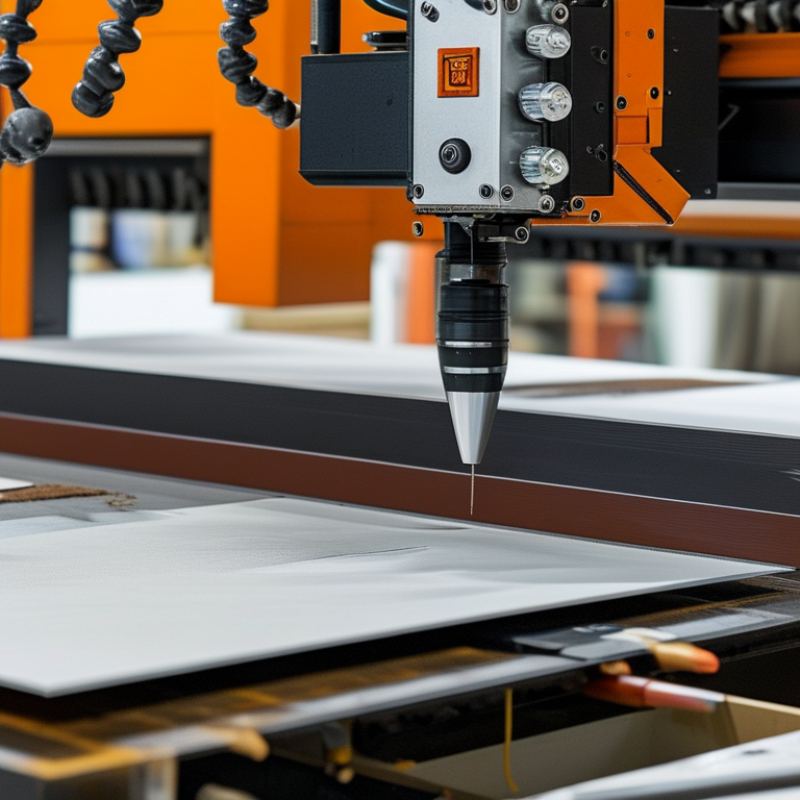
Define Materials and Thickness Ranges: Fiber at 1.06 μm for Metals
Choosing a CNC laser cutter starts with two questions: what material will it process, and how thick? Fiber lasers operating near 1.06 μm are widely suited to steel, stainless steel, aluminum, brass, and other reflective metals. Their wavelength couples efficiently with many metals, but absorption varies with alloy, surface finish, and temperature. Metal changes everything. A 2024 Grand View Research report estimated the global laser cutting machine market at USD 6.83 billion in 2023. It projected 6.7% annual growth through 2030, although market estimates differ by scope. That caveat matters.
Build a thickness matrix before comparing machine prices. List regular jobs, not occasional successes: 1 mm stainless steel, 6 mm carbon steel, or 12 mm aluminum. Then verify rated thickness, piercing time, kerf width, edge tolerance, and assist-gas requirements. A 3 kW system may cut thin sheet quickly yet struggle with thick aluminum or copper. Reflective materials require suitable optics, beam control, and validated operating limits. ISO 9013 provides a useful framework for evaluating thermally cut-edge quality. Do not trust a maximum-thickness claim alone. Request sample cuts using your actual alloy and thickness. My own selection mistake would be treating nominal power as productivity. It is only one variable.
7 Tips to Choose a CNC Laser Cutting Machine? - Define Materials and Thickness Ranges: Fiber at 1.06 µm for Metals
| Tip | Decision Dimension | Recommended Specification | Typical Practical Range | Why It Matters |
|---|---|---|---|---|
| 1 | Confirm the material family | Use a continuous-wave fiber laser with a wavelength near 1.06 µm for electrically conductive metals. | Carbon steel, stainless steel, aluminum, brass, and copper. | A 1.06 µm fiber beam is efficiently absorbed by most metals and is generally more suitable for sheet-metal cutting than a 10.6 µm CO2 beam. |
| 2 | Define the thickness range | Select laser power according to the thickest material that must be cut at the required quality and speed. |
Typical carbon-steel capability: 1–3 kW: approximately 0.5–16 mm 4–6 kW: approximately 0.5–25 mm |
Maximum advertised thickness is often a slow, single-cut limit. A practical production thickness is usually lower. |
| 3 | Match power to each metal | Use a power level that accommodates reflectivity, thermal conductivity, and the desired edge quality. |
Approximate range with suitable process settings: Stainless steel: 0.5–20 mm Aluminum: 0.8–20 mm Brass: 0.5–12 mm Copper: 0.5–10 mm |
Aluminum, brass, and copper reflect more near-infrared energy and conduct heat quickly, so they may require higher power, specialized cutting heads, and careful piercing settings. |
| 4 | Choose the cutting gas | Specify oxygen, nitrogen, or compressed air based on edge requirements and operating cost. |
Oxygen: carbon steel cutting Nitrogen: stainless steel and non-ferrous metals Air: economical general-purpose cutting |
Oxygen can increase carbon-steel cutting speed through an exothermic reaction, while nitrogen helps produce cleaner, oxide-free edges on stainless steel and aluminum. |
| 5 | Check the work area | Choose a table size that supports the largest standard sheet and leaves sufficient loading clearance. |
Common working formats include: 1,500 × 3,000 mm 2,000 × 4,000 mm 2,000 × 6,000 mm |
A correctly sized bed reduces sheet handling, scrap, repositioning, and the risk of cutting outside the usable travel area. |
| 6 | Evaluate accuracy and speed | Review positioning accuracy, repeatability, acceleration, and piercing time rather than relying on maximum travel speed alone. |
Typical sheet-metal positioning accuracy: about ±0.03–0.05 mm Typical maximum traverse speed: approximately 80–140 m/min |
Real throughput depends on contour complexity, material thickness, pierce count, acceleration, gas pressure, and nesting efficiency. |
| 7 | Verify safety and operating cost | Select a fully enclosed Class 1 system with interlocked doors, fume extraction, chiller monitoring, and suitable electrical protection. | Include costs for assist gas, electricity, filters, protective windows, nozzles, lenses, maintenance, and cooling. | A machine with lower purchase cost may have higher total cost of ownership if consumables, gas consumption, downtime, and maintenance are overlooked. |
Note: Thickness figures are typical planning ranges for modern fiber laser systems using a 1.06 µm-class wavelength. Actual performance varies with laser power, material grade, sheet flatness, nozzle condition, focus position, assist-gas purity and pressure, cutting speed, and the required edge quality. Always validate the intended materials and thicknesses with production samples before purchase.
Related Posts
-
The Future Landscape of Global Manufacturing in 2025 with Best Laser Cutting Machines
-
2025 Trends in Precision Manufacturing: Harnessing the Power of the Best Industrial Laser Cutting Machines
-
How to Choose CNC Laser Cutting Services in 2026?
-
Innovative Applications of Cnc Tube Cutting Machine in Various Industries
-
Innovative Alternatives to the Best Drilling Machine for Your Project Needs
-
Discover Cutting Edge Innovations at the 137th Canton Fair for Cnc Steel Cutting Machine Buyers